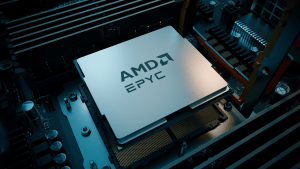
As the demand for computing power intensifies – whether in AI, virtualisation, or cloud infrastructure – organisations are increasingly faced with a twin challenge: how to boost performance without driving up energy usage. It’s a tough balancing act, and one that many traditional server processors struggle to pull off. Fortunately, AMD EPYC™ Processors have carved out a reputation for delivering exactly that: CPUs for higher performance but lower power consumption.
The Real-World Challenge
Modern IT infrastructures are under pressure from all sides:
- Scaling performance drives energy costs: As you scale up core counts and push frequencies higher, power consumption and heat generation often rise in tandem – unless your architecture is built with efficiency in mind.
- Total cost of ownership matters more than ever: Running more servers doesn’t just mean more performance – it also means more power, more cooling, and greater physical footprint.
- Sustainability goals are becoming non-negotiable: Businesses are now expected to meet internal carbon reduction targets and external regulatory benchmarks alike. Efficient hardware isn’t just a “nice-to-have” – it’s fast becoming a necessity.
Key Factors Driving the Adoption of Processors for Higher Performance but Lower Power Consumption
- Energy Efficiency – Reduces overall power consumption while maintaining or improving compute output
- Performance Scaling – Delivers higher core counts and throughput without a linear increase in energy use
- TCO (Total Cost of Ownership) – Lowers long-term costs by reducing energy bills, cooling needs, and hardware footprint
- Core Density & Architecture – Advanced core designs (Zen 4c, Zen 5c) allow more cores in a smaller thermal envelope
- Real-World Energy Savings – Organisations report 25%–40% reduction in power usage for the same or better performance
- Environmental & ESG Goals – Supports corporate sustainability initiatives and helps meet regulatory benchmarks
- Workload Versatility – Optimised for a wide range of tasks including virtualisation, cloud-native apps, and edge computing
- Platform Adaptability – Offers configurations for both full-scale data centres and edge or remote deployments
- Performance per Watt – Superior compute output for every watt consumed, maximising efficiency per unit of energy
- Future-Ready Infrastructure – Supports PCIe 5.0, DDR5, and CXL for scalable and efficient future deployments
How AMD EPYC™ Strikes the Balance
AMD’s latest EPYC™ processor generations – namely the 9004 and recently launched 9005 series – bring a series of deliberate design choices that help them stand apart when it comes to energy-conscious performance.
- Smaller, smarter transistors
Built using TSMC’s advanced 3nm and 4nm nodes, AMD EPYC™ processors squeeze more performance from every watt of power, thanks to improved efficiency and reduced leakage. - High-efficiency core designs
With Zen 4c and Zen 5c architectures, AMD delivers dense compute with lower thermal and power requirements. These variants are ideal for scaling workloads without scaling energy bills. - Proven real-world savings
In real deployment scenarios, organisations moving from older platforms to AMD EPYC™ CPUs have seen performance gains of over 40% – and simultaneous power reductions of up to 30%. - Modular and workload-specific platforms
AMD introduced the SP6 socket for lower-power platforms, targeting edge environments or constrained racks, while maintaining top-tier performance with SP5 for full-scale datacentres. - Better per-core and per-watt outcomes
Whether you’re running 1,000 VMs or hosting containerised applications at the edge, AMD EPYC™ processors are designed to give you more performance per watt, per rack unit, and per pound spent.
Why It Delivers: Tangible Business Benefits
Organisations that have already made the switch to AMD EPYC™ have reported:
- Substantial energy savings on workloads such as virtualisation and high-performance databases
- Fewer physical servers needed for the same – or greater – throughput, helping shrink datacentre footprints
- Lower cooling overheads, with fewer fans, chillers, and HVAC systems required to manage heat
- Environmental impact reduction, helping meet internal sustainability KPIs and public ESG targets
Who Should Choose AMD EPYC™ Processors for Energy Efficiency?
If you’re evaluating infrastructure upgrades and energy use is a key factor, AMD EPYC™ CPUs are particularly well-suited for:
- High-density virtualisation platforms needing efficiency at scale
- Cloud-native deployments that require efficient, scalable infrastructure for containerised workloads
- Edge sites and micro-datacentres where power and space are limited
- Enterprises focused on carbon reduction as part of their broader ESG commitments
- Organisations looking to cut long-term operational costs while boosting performance
In essence, if your business depends on doing more with less, AMD EPYC™ Processors are a smart choice.
Looking Ahead: The Future of Efficient Compute
The trajectory for server CPUs is clear: greater performance at lower power envelopes will become the baseline. AMD is already well ahead of the curve with EPYC™:
- Zen 5 and 5c continue pushing core density without ramping up wattage
- Support for PCIe 5.0, CXL, and DDR5 means better resource sharing and lower I/O bottlenecks
- Strong partnerships with OEMs and cloud providers ensure the ecosystem is ready
- Energy-efficient tuning at the BIOS, firmware, and OS layer gives admins greater control over power use
- Regulatory trends across Europe and the UK are favouring lower-carbon infrastructure – AMD EPYC CPUs align well with this direction
For anyone planning their next refresh or datacentre expansion, it’s worth looking closely at AMD’s EPYC™ roadmap – it’s not just about more power, it’s about smarter power.
Final Thoughts
Choosing processors for higher performance but lower power consumption is no longer about compromise – it’s about optimisation. AMD EPYC™ processors deliver a blend of top-tier performance and remarkable energy efficiency that’s already reshaping expectations in enterprise and cloud computing alike.
Whether you’re focused on reducing OPEX, improving sustainability, or simply getting more out of your infrastructure, AMD EPYC™ CPUs are designed to help you get there – efficiently.
Contact our experts today to discuss solutions